
This piece was originally Published in Almanassa.
Songbirds usually fail in their first attempts to learn how to sing. But they improve with each subsequent try.
They learn their songs in much the same way a child learns to speak: by watching, trying, failing, and repeating until they succeed. A child picks up on this through the reactions of their parents and the adults around them. A correct word brings a positive response; an incorrect one elicits laughter and correction. Through these simple interactions, the child begins to form their pronunciation and strengthen the muscles needed for speech, then gradually forms coherent sentences.
This sequence of reactions isn’t arbitrary, even if we perform it out of habit. It’s actually a complex process, carefully designed to achieve a specific outcome: that a child exits a particular developmental stage capable of communicating with others of their species, able to understand them and to express what they want others to understand.
Learning from older members of the species isn’t unique to humans. Many mammals and birds acquire essential survival and reproductive skills from older, more experienced individuals in their groups. This is how core skills and cultural knowledge are passed down from generation to generation. This is how birds learn their songs.
In species that rely on this method of information transmission, group size becomes critically important. Any change in biodiversity, due to habitat destruction or other causes, will naturally lead to smaller group sizes, and thus disrupted social structures. The natural result is a breakdown in learning mechanisms.
Disrupted Melodies
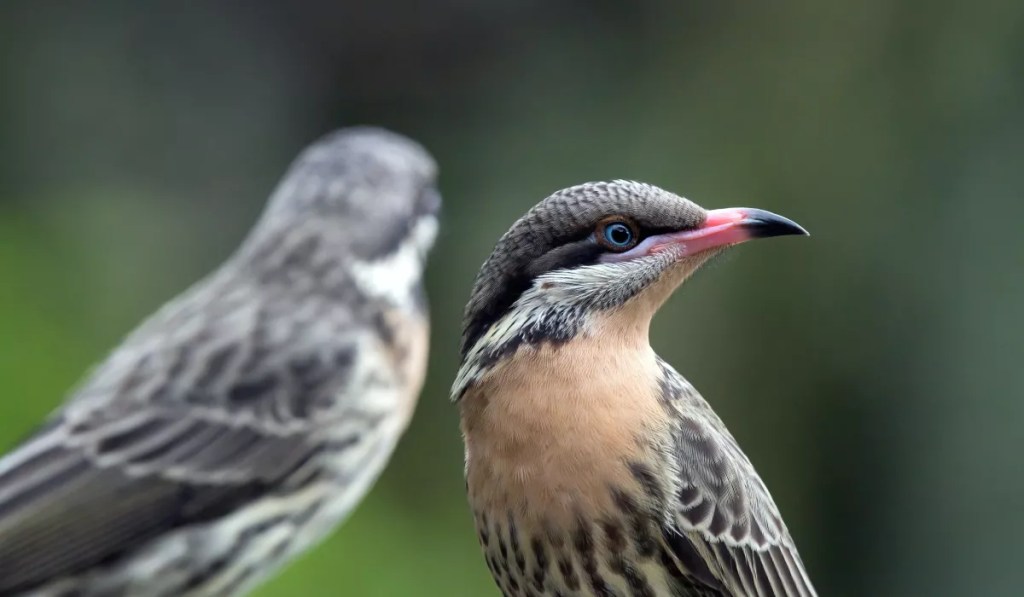
In a study published in the Proceedings of the Royal Society, researchers investigated honeyeaters, a medium-sized bird species native to southern Australia, known for their bright yellow tails and black and white chests. In recent years, their numbers have plummeted, and estimates suggest there are only about 300 left in the wild today.
Researchers studied the songs of these birds in healthy, full-sized groups and described them as “complex” and “long.” They then compared these songs to those of the same species in environmentally degraded, fragmented populations.
They found a clear difference: the songs were significantly shorter and less complex in smaller, disrupted groups. In many cases, the honeyeaters were observed trying to mimic the songs of other bird species, as if they no longer knew what they were supposed to sing.
The natural consequence is a loss of key social functions. These birds become less attractive to females, decreasing their chances of mating. This leads to further population decline, which results in even lower song quality, a vicious cycle.
Why Do Honeyeaters Sing?
Honeyeaters have faced many challenges. Deforestation in their habitats has destroyed much of the environment they depend on. Add to that their small body size, their vulnerability to environmental change, their reliance on a specific type of nectar, and their evolutionary preference for large social groups—all factors contributing to their decline.
The primary cause of their lost songs is the dispersal and shrinking of groups, making it harder for younger birds to learn the correct melodies, the primary currency of communication. The problem worsens when young birds start learning the wrong songs from other species, which hold no value to potential mates and may even repel them.
The data from the study makes it clear: the confusion in song culture plays a significant role in compounding the original problem.
About Singing
Research into birdsong can be traced back to the late 1950s, especially the work of scientist William Thorpe. He took advantage of advances in sound-recording technology to study bird songs in greater detail. In one of the earliest recorded studies, Thorpe raised Fringilla coelebs finches in his lab. Those that reached maturity without hearing the songs of adult males developed distorted songs, markedly different from the ones used to attract mates.
To confirm his findings, Thorpe exposed other young birds to field recordings. These birds, when exposed during their learning phase, were able to imitate the correct tunes quickly.
In contrast, adult birds who listened to the same recordings showed no change. Their learning window had closed. This led Thorpe to believe the process was time-sensitive: once a bird passes a certain age, it loses the ability to learn the correct song.
His research concluded that birds learn their songs early in life, and the absence of an adult “tutor”—usually a male—leads to confused and incorrect melodies.
Since then, birdsong has become one of the most studied areas in the field of “cultural” interactions among animals. Young birds learn how to sing from older ones, through trial and error.
What It Means to Be a Bird
I stumbled upon this paper in March 2021, a month after my father passed away due to a severe case of COVID-19. At the time, the virus dominated every aspect of life, everything revolved around it, and anything unrelated felt unworthy of discussion. That was the shape of the world then. Sometimes I find it hard to believe it wasn’t all a dream. The retreat of the pandemic, the return of crowds and traffic, the disappearance of face masks, all of it makes me wonder: did that really happen?
I initially read the study out of professional interest. But then things got out of hand. This wasn’t a field I typically followed, I didn’t know enough about it to care deeply. Yet I tried, with every tool I had, to understand it fully. Why the obsession? Good question. I don’t know exactly. But the image of a bird singing songs that no one understands, it never left me.
Many specialists in animal behavior warn against projecting human emotions onto nonhuman creatures. One professor once said: “When a dog loses its sight, it loses its ability to see—but it doesn’t go blind.” His point was that blindness is a cultural concept, while sensory loss is a biological reality. The dog will adapt using other senses. Still, I didn’t take that advice to heart, even though I often repeat it myself.
In April 2021, I wrote a long email to the study’s lead researcher. I asked about many areas I didn’t fully understand. Among them: “Does a bird lose its sense of self when it can no longer sing a coherent song?” His response was somewhat surprised, perhaps because the question itself is unusual for the field, not something a respectable science journalist would normally ask. But he answered anyway: “These birds are still aware that they are honeyeaters.” I really liked that idea. But he added: “They’re singing the songs of other birds. So, you could say they’re a bit confused, ignorant, even.”
What I keep thinking is: we will never know what it means to be a bird, of course. And there’s no point in trying to find out. We won’t know. We will never know what it feels like to sing a song that none of your own kind can understand.
But that image has settled in my mind, perhaps for good.
 Ahmad Gamal Saad-Eddin
Leave a comment