
It is hard to encounter a show based on true events, without wondering: What is true in what we watch or read? What happened in reality? And what was added to the events for the drama’s sake? Curiosity here is very common, particularly since the spaces where the creators seem, from the first moment of the series, clouded and unclear except for those who know the truth behind them.
It seems that the creators of the latest “Chernobyl” series were haunted by this thought; they mentioned on many occasions and in interviews that there is ample space between reality and fantasy and that any dramatic attempt to re-enact the event should be taken with care and caution, “We resort to reality because it is really impressive but then we reformulate it into a story.”
A Fracture in the Structure of a State
Chernobyl disaster, from the first moment I realized its extent and impact, was associated with a story by the Egyptian writer Mohamed El-Makhzangi, in his short story collection, “The Descent of the Whale”, whose chapters were written in the year the disaster occurred, and the first edition was published in 1998. This is how I knew about what happened, and realized the outlines; from an Egyptian writer who was living through the heart of the experience at that time, in the city of Kyiv in Soviet Ukraine back then. Then he decided to write what he witnessed later.
El-Makhzangi describes, once this collection was released, what happened as a fracture in the entire structure of the Soviet Union. The same remark was expressed by Mikhail Gorbachev, who was the General Secretary of the Communist Party of the Soviet Union back then, several years after the disaster, in 2006, that Chernobyl was the main cause of the Soviet Union’s final collapse.
However, it goes beyond politics and unions collapsing. Observation of this catastrophe tells us a lot about human souls and social relations, about science and our relationship with it. It wasn’t a simple incident by any measure, matters like that don’t occur every day. But as they do, we receive a huge amount of actions and reactions to examine and reflect on.
The Cost of lies
Nowadays, Chernobyl is back in pop culture, perhaps with an intensity that hasn’t happened since the accident. Following its launch, HBO produced five-episode drama series, each one about an hour long; it has dominated social media and drama websites with high viewing rates. By the time the final episode was released on June 3, 2019, the series was ranked first on IMDB’s list of best TV shows.
There are many reasons for the mass and critical success of the show, also its immediate rise to the list of the top dramas in 2019. The disappointing end of “Game of Thrones”, also produced by HBO, cannot be overlooked. But among the repeated comments about what makes “Chernobyl” “crucial” is the remark about the incredible accuracy in recreating such a historical moment with all its surroundings, making the whole show a perfect attempt (except for some loopholes), that draws an accurate picture of people who witnessed and dealt with the incident closely. As for what makes the show “relevant” to the present historical moment, it is that its fundamental idea is based on one question: What is the cost of lies?
An Attempt for a Close-up Narrative
In the series, we’re introduced to three main characters, and many secondary characters, most of which are real people closely involved with the nuclear reactor explosion. Valery Legasov (played by Jared Harris) is the story’s protagonist, known as a member of the Academy of Sciences of the Soviet Union, in the same position as the real person, and as a key member of the committee to investigate and manage this disaster. He is also accompanied by Boris Shcherbina (played by Stellan Skarsgård), who was Deputy Prime Minister at that time, supervising the entire Rescue Committee. From the beginning of the series, these two characters move together and their personalities, bit by bit, evolve.
Legasov seems flustered all the time, with nothing in his mind except what he already knows that often allows him to make scientifically critical decisions, and to raise objections that might not have been permitted in other circumstances. When Shcherbina’s rigor breaks down, revealing a very anxious person who has clear moral standards when necessary.
The third character, the physicist Ulana Khomyuk (played by Emily Watson), a character who we discover at the end of the show that she did not exist in real life but rather invented as a dramatization of the large research team that worked with Legasov to assess risks and make decisions during handling the nuclear disaster.
The series writer is Craig Mazin, whose works before “Chernobyl” were, ironically, comedies; he took part in the making of “The Hangover” and “Scary Movie” series. The director is Johan Renck, whose work before Chernobyl came from the world of music videos, he also directed three episodes of the super popular series, “Breaking Bad”; most of his work is irrelevant to science but more of thrillers and drama.
The plot of “Chernobyl” is simple; maybe because there isn’t plenty of room for improvisation amid this horror and maybe because the irony is greater than the dramatization in the first place: an explosion occurs in an operating nuclear power reactor and a group of scientists is trying to understand the disaster and contain its effects before it develops. The events context also includes the Soviet authorities, who impose a strict information blockade on the matter, and constantly intervene to direct the procedures. Therefore, the scientists’ job becomes the resistance to the radioactive effects as well as the bureaucracy of the Soviet state, whose role in the disaster is revealed by the passing of time.
Connotation of Pregnancy
A woman gets on a bus; five men get up at once, offering her their seats while other passengers stare at her. Usually, one person does offer, sometimes two. But five seems a bit too much.
This happens at the beginning of El-Makhzangi ‘s story, which I recount a lot from the collection “The Descent of the Whale.” At the end of the story, we know the woman is pregnant and people are gazing at her belly, overwhelmed with all possible feelings and fantasies, because she is no longer just a pregnant woman.
Readers already knew in the first pages of the book that the stories take place in Kyiv, the capital of Soviet Ukraine, several years after the Chernobyl disaster that its repercussions are still present. These stories are like a preview of the lasting aftermaths of the incident. All of the collection’s stories are written in the first person; the writer is the witness, the observer. From the beginning, El-Makhzangi reveals that the stories are a sort of realistic narration, what he calls “Fictional Reportage”. While people gaze at the pregnant woman and what she carries inside her, they think, without a doubt, about a matter that each one of them lives, she bears its good and bad omens alike: radiation and its effects.
Like most of the stories in the collection, this one is as tangled as the narrative and the events are simple. Nothing weird happens in any of the stories, the strange is the people’s lives and what the narrator’s living among them. Everything is a reaction to one gigantic event. There is always a hint of something indescribable but everyone feels it perched over them like radiation they cannot help but think of it all the time, but none of them see it. Successive signs, each one carrying a glimpse of life at that moment in history, is what the writer was witnessing day by day.
Chain Reaction and Radioactive Contamination
At the dawn of April 26, 1986, a problem occurred during regular maintenance for reactor No. 4 of The Chernobyl Nuclear Power Plant which is located near Pripyat city, 130 kilometers away from Kyiv, the Ukrainian capital.
Pripyat is a simple city, completely designed in the early 1970s, as one of the “closed cities” that the Soviet Union was building around strategically important facilities, especially nuclear ones. Even its name, Pripyat, is not an original one but rather the river the city overlooks. Usually, entry into these cities required a permit from the relevant authorities. But Pripyat was an exception. Even the Chernobyl reactor, three kilometers away, was of little or no apparent significance at that time.
The Soviet Union invested heavily in nuclear energy after World War II. The dropping of the atomic bomb on two cities in Japan, (Hiroshima on August 6, 1945, and Nagasaki three days later), was with a terrifying and violent impact on all humanity so it caught the attention of many. World War II transformed the course of many events in human history, but it specifically opened the door wide for investment in this type of massive energy. In the seventies, the Soviet Union began building nuclear reactors to generate energy. Among them were four RBMK-1000 nuclear reactors at a power generation facility on the Belarusian-Ukrainian border. Reactors 1 and 2 were built between 1970 and 1977, while reactors 3 and 4 were completed in 1983.
The RBMK-1000 reactors are characterized by being mainly run on graphite and the Soviet Union kept the technology of these reactors in particular for itself, preventing the export to other countries.
This seemingly containable problem triggered an uncontrollable chain reaction (the idea of a chain reaction is that a particular chemical reaction triggers a series of reactions, which in turn lead to more reactions, in an ongoing chain), that ended up with a full-on explosion on the reactor No. 4, exposing its burning core to the air. As a result, radioactive elements including plutonium, iodine, strontium, and cesium were scattered into the area around the reactor. While the graphite rods ignited, the radioactive elements increased in the surrounding environment.
This is the worst nuclear and environmental disaster in the history of mankind; the entire surrounding area was radioactively contaminated. Also in the first weeks of the disaster, according to official reports, about 30 workers died, most of them were firefighters and first responders, in addition to the exposure of 600,000 people who took part in evacuations, extinguishing, or cleaning operations to various forms of radiation.
According to the report of the United Nations Scientific Committee on the Effects of Atomic Radiation (UNSCEAR), in 1986, more than 115,000 people were evacuated from areas near the nuclear reactor and relocated to other places. Vast areas of Belarus and Ukraine were damaged by radionuclides, moreover, radiation effects were detected in all the northern hemisphere countries.
Overall, more than eight million people in Belarus, Russia, and Ukraine were exposed to radiation of various degrees; an area of approximately 155,000 square kilometers of territory in these countries has been contaminated.
There are more than one hundred radioactive elements released during the disaster, most of them were short-lived and decomposed rapidly. However, other radioactive materials are more aggressive and dangerous. Three of the major radioactive elements appear here: radioactive iodine (with a half-life of eight days), radioactive strontium-90 (with a half-life of 28 years), and radioactive cesium-137 (with a half-life of 30 years), some of the elements still could be traced in the environment around the reactor until this very day.
According to the report of the International Atomic Energy Agency, there are at least 1,800 documented cases of thyroid cancer in children, ranging between one and 14-year-old, which is much higher than the normal rate, as the thyroid gland in children is highly sensitive to the absorption of radioactive iodine, one of the main causes of thyroid cancer.
While radioactive iodine is related to the thyroid gland, radioactive strontium-90 is related to leukemia. As for caesium-137, it’s the ablest to cover large sectors of land and the longest-lived. These elements, on the whole, impact the entire body and pose a serious threat, particularly to the internal organs.
It wasn’t until more than 36 hours after the disaster that Soviet officials decided to begin the evacuation of Pripyat. In just four hours, the Russian forces were able, with true efficiency, to remove nearly 49,000 people from the city in a fleet of 1,200 buses, crossing the road to and fro. We know that Shcherbina’s decisions and Legasov’s warnings, both in reality and in the series, had a profound impact on the process of decision-making that day, after several attempts to control the situation internally.
By the third day, the Soviet Union still didn’t issue any statements about the disaster, until the radiation reached Sweden. There, a map of increasing radiation levels and wind directions was drawn up, and only then Sweden announced to the world: there had been a nuclear accident somewhere in the Soviet Union. In the end, the Soviet Union had no other choice but to admit that a nuclear catastrophe had occurred in a short statement on April 28th. The whole world instantly realized that we are facing a historic moment, as 30% of the 190 tons of uranium in the reactor is burning and spreading in the air.
Voices from Chernobyl
It was clarified among the reasons the Belarusian writer Svetlana Alexievich won the Nobel Prize in Literature 2015 “for her polyphonic writings,” which is an expression of great accuracy.
Alexievich has written several books that are categorized as documentary novels, chronicling people’s lives through their personal accounts. Her work mostly covers life under the Soviet Union but apart from the official accounts. Her main concern was the stories of the stories, narrated in their own words and descriptions. The result is a combination of journalism and literary work; she is a journalist addressing and documenting a specific incident and a creative literary author in her language and narrative.
This makes her work a blend of investigative journalism, psychological observation, and historical fiction. All at the same time. All in the same story.
In 1997, more than eleven years after the nuclear disaster, Alexievich published her book “Voices from Chernobyl: The Oral History of a Nuclear Disaster” (titled Chernobyl Prayer: A Chronicle of the Future in the UK). The book isn’t really about the explosion of the nuclear reactor in itself or its causes; though the explosion seems absent, we comprehensively witness its impacts on people. The book isn’t about the reactor at all, but about the world the disaster created, the ways people interact with each other, and the new reality that followed using their voices, descriptions, and expressions of what they went through.
This way of writing is understandable; in the midst of momentous events, people are forgotten. Their news and personal thoughts are neglected and marginalized in the general framework of the panic that envelops everything. It’s attention-grabbing to know that the Russian authorities have released, from the time of the accident until now, only a few documents and information related to the explosion. The death toll remained at thirty-eight.
Attempts to document Chernobyl are indeed numerous but all of them are controlled by two main limitations: lack of information and the uniqueness of the incident that makes any approach bound by a great deal of speculation about the effects rather than the event itself.
Chronicles of a Disaster
This is what “Chernobyl” seems to capture in glimpses. As the show begins from inside the reactor directly, at the moment of the explosion with all the characters very close to it. Personal stories are rarely mentioned and only as a way to conclude some scenes. The series, then, attempts to carry out a dramatic “history” of this incident which is thoroughly different from both El-Makhzangi’s and Alexievich’s; the main difference between the three of them is the distance each one places from the incident.
Leo Tolstoy, the most famous Russian writer, in one of the sayings attributed to him, says that all great stories are one of two: a person who goes on a journey or a stranger who comes as a guest in a city. This proverb can be easily recounted in El-Makhzangi’s collection; it consists entirely of a stranger’s observation who visited a city doomed to radiation. Each of his stories is a contemplation of a deep aspect of a human tragedy and the way people are surviving it. The narrator, who comes from a developing country, witnesses with his own eyes the collapse of communism’s gigantic dream, a violent collapse that El-Makhzangi likens to the feeling of Sinbad who lands on an island, as it happens in one of the stories of One Thousand and One Nights, and discovers that this island is just the back of a whale about to dive. People in the stories are only immersed in their own thoughts, but they lose faith in the system that yielded this harsh moment.
As for the explanation of what actually happened in the reactor, it’s relevant to the other example, a person who goes on a journey. Or four people, to be accurate. The final episode of the series presents a full explanation of this journey, in every detail.
So, the Chernobyl series, it’s an attempt to recreate the incident through a significant degree of commitment to the way of life at that moment in history, both in the characters’ clothing styles and the social and cultural climate on a large scale.
The most fictional aspect of the series is the character Ulana Khomyuk, who represented what could be considered Legasov’s “conscience” that pushes him towards determining right from wrong. She wasn’t real. Although the Soviet Union was conservative in allowing a woman to have a career and move her way up the ladder, science and medicine were the exceptions, which seems to be what the series tried to embody by integrating all members of the emergency team into “Ulana”, who was too idealized, so to speak.
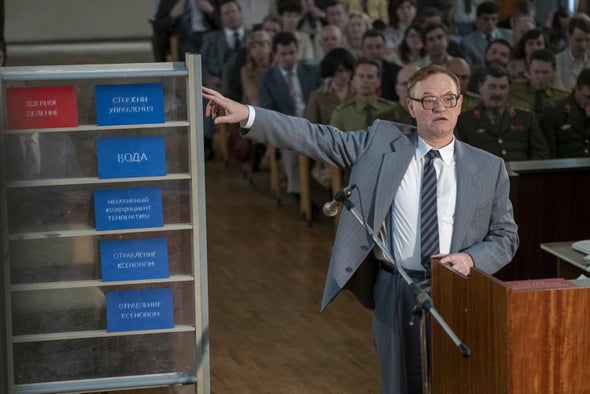
In a solemn courtroom scene, Legasov tells that the disaster occurred mainly because the control rods (which imitate the brakes in the world of nuclear reactors) were supposed to slow down the reaction as they were able to absorb neutrons without splitting themselves. But that’s not what happened, because the control rods’ ends contained graphite that increased the reaction, instead of stopping it. When the Attorney General asked him why the graphite was used in these safety brakes, he replied: Because it is cheaper. Here the error goes beyond being a human mistake, caused by a group of men, sitting to be tried, to “be purely a management system mistake.”
On the other hand, pregnancy is a “fundamental theme” throughout the incidents. The reference to the pregnant woman on the bus, in El-Makhzang’s story, is repeated in one of Svetlana Alexievich’s stories in her collection “Voices from Chernobyl”, and it is exactly the story that the TV series uses as it appeared in the book. Telling the story of Lyudmilla Ignatenko (played by Jessie Buckley), who managed to stay with her husband, despite the ban imposed on all the affected by the respondents to the incident. Her husband was a fireman, and his unit was among the first mobile units that moved to deal with the reactor fire. His body was severely affected by the radiation, and then, after a while of suffering from the effects of the radiation burns, he died. Even though she was carrying a baby in her womb at that time, Lyudmilla stayed by her husband’s bed. She lied to the nursing staff and told them that she wasn’t pregnant. Her baby only lived for four hours, then died, obviously, the baby’s body had entirely absorbed the radiation.
Other than this scene, and another casual scene about migration, the series doesn’t seem interested in the direct effects on the people. Probably due to the limited number of its episodes; and the decision to shorten and intensify it (the series’ writer, Mazin himself, said that the target was to reach 10 episodes, then it was shortened to 5). Even when we come to one of the most psychosocially violent scenes in the series, when a group goes out to hunt animals-already a standard procedure at that time; we don’t see it from the pet owners’ perspective, but rather from the perspective of the soldiers, who handle these hunts.
The Finale
The final episode is unique to the incidents’ narration in the control room in detail; a dramatic vision of the moments that preceded the reactor explosion, in parallel with a dramatic recreation of the trial scene of those responsible for the tragedy. These are the moments that form the entire series’ narrative tightly; not only as opposed to nuclear energy in particular but also opposed to the risks it carries, especially in a highly bureaucratic environment like the Soviet Union. As Legasov stands in front of a board divided into two parts: one part for the blue cards (which represent the brakes of the nuclear reactor), and another part for the red cards (which represent the reaction catalysts). The way a nuclear reactor works seems to be quite obvious to the unprofessional audience.
It is that moment of scientific understanding, in all its simplicity, that creates the aspired dramatic influence. When Legaslov begins to remove the blue cards one after another, the viewer understands where things are heading now. Now, there’s nothing left to break on this reactivity, except for one card; it represents the boron rods, which are the last intervention element to stop the nuclear reaction. But, as it unfolds, the management overseeing the construction of the nuclear reactor chose a cheap type, with a graphite head that increased the reaction rather than stopping it, once running in case of emergency. Accordingly, the series’ last episode can be described under the heading of dramatic processing in order to “simplify science.”
Stating that this scene represents the series’ narrative, is an expression that also applies to the fact that it represents the series’ dramatic depiction itself. In reality, things at the trial didn’t happen that way at all, and Legasov wasn’t even present. However, the dramatic recreation here makes his presence, to deliver his deeply influencing closing lecture, necessary.
The people in the courtroom on the bench weren’t the only ones responsible for the disaster, of course, they were an intrinsic part but it was more than that. Lies, deception, bureaucracy, and corruption are just as guilty as them, perhaps more.
We Need Help
In 1990, the Soviet Union announced, for the first time, its need for international help. Accordingly, the General Assembly adopted Resolution 45/190, calling for international cooperation to mitigate the disaster’s effects.
The remainder of the reactor is inside a giant steel containment structure container: which was placed in this location in 2016. These clean-up attempts are expected to remain until 2065. The area surrounding the reactor, 30 kilometers in diameter, known as Chernobyl Exclusion Zone, is considered uninhabited.
Certainly, the effects are still being researched. However, there: the area around the reactor, about four meters in diameter, the forests suddenly turned red. Known as the Red Forest, its foliage became a mixture of red and gray and died. This all resulted from the high levels of radiation; that they were exposed to.
The Eternal Memory
In one of the stories of the Descent of the Whale, the narrator tells how the people, who have been robbed of the joy of summer and its picnics, exploit the opportunity of the bitter winter to go out to the skating rinks, which are originally frozen lakes. The narrator, who comes from a country that does not know these things, struggles a lot, despite his friends’ attempts to teach him how to skate properly. This snowshoe is overwhelming, and the movement on the ice is difficult, let alone skating on it and controlling the steps while doing that. With repeated falls, a skater’s voice echoes advising the group: teach him how to fall first. How to control his body when he is out of balance and how to fall on the fleshy parts of his body to decrease the pain of the fall. The narrator finds it a pleasant idea. To learn how to fall, before he learns how to move, which is already happening.
Over and over, he falls over and over. And each time he falls, his fall becomes better than the previous one. When he masters these falling skills, he surprisingly realizes that he can skate freely now; he knows exactly how to handle it if he loses his balance, without hurting himself.
The Chernobyl accident had a profound impact; in terms of its surprise factor, and the area of its impact. Besides, it is a unique incident. Officials had no idea what disaster of that magnitude meant, nor the basic acts for such circumstances. It was a space for improvisation.
The final episode is titled “Vichnaya Pamyat,” a Ukrainian expression that can be translated as eternal memory, is an accurate expression of what happened in Chernobyl, and the impact of this incident in the recent period. It is a memory that lives in our consciousness as repeating Chernobyl explosion is a possibility. That combination of arrogance, ignorance, and impulsiveness usually causes disasters like these, and the exceptional cases are few already.
El-Makhzangi’s story about falling can be read and interpreted in more than one way. As with all good stories, it carries within itself ideas that belong to the vast area of human existence. However, I find it the best representation of the whole theme of the collection. What El-Makhzangi was trying to say throughout its sequence of stories: we must learn and think to prepare ourselves if things fail to reflect our wishes and what we will do to handle the consequences, before we run recklessly toward a terrifying power such as nuclear energy, because we will not bear the cost of the losses, and because the cost of lying-here appears the series and its narrative-is collapse. As Legaslov’s voice says in the final episodes: its cost is not limited to neglecting the truth once. However, hearing enough lies eventually makes us lose any potential ability to recognize the truth, even when we see it.
All of these stories and dramatic attempts to deal with the incident, also tell us that we need to know more about the truth. Imaginary attempts, stories, and novels are great elements for understanding emotions and thinking about deeper areas of human sensations. But by their nature, the nature of abridgment, condensation, and intensification, they don’t convey an accurate image of the incident. The real disaster is when facts disappear among all these literary and dramatic attempts and works of art become our only perception of what happened.
This article was originally published in The Arabic Edition of Scientific American
 Ahmad Gamal Saad-Eddin
Leave a comment